


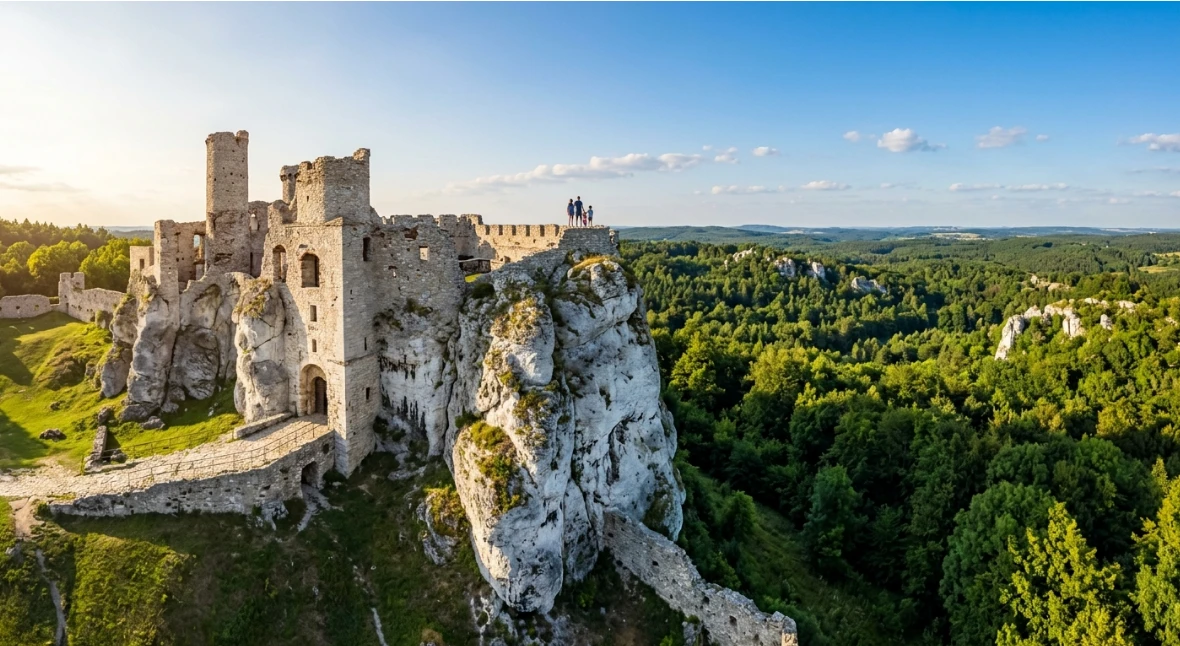
Poland has more than 400 castles. That number surprises most first-time visitors, who arrive expecting Kraków and leave wondering why nobody told them about Moszna, Niedzica, or the fairytale ruins of the Jura trail. The country has been fought over, rebuilt, burned, ransacked by Swedes, occupied by Germans, and somehow – against all odds – many of its finest medieval and Renaissance fortifications survived well enough to be extraordinary today.
The castles are spread across the whole country, which means that hitting the highlights by public transport is unrealistic. By car, it’s a different story entirely. You pick a region, load the kids, and spend a week driving between limestone hilltop ruins, baroque palace complexes, and brick Gothic fortresses that make the Teutonic Knights feel genuinely present. This article lays out a practical route covering the best castles in Poland, broken into regions you can combine or tackle separately.
Why a car is essential – and how to sort the rental
Many of Poland’s most spectacular castles sit outside major cities, in small towns and villages with no practical rail or bus connection. Moszna is a 30-minute drive from Opole, but there’s no regular bus. The Eagle’s Nest Trail castles in the Jura are scattered across limestone hills with narrow access roads. Niedzica requires a mountain approach road. The drive itself is often part of the experience.
Poland’s road network has improved dramatically in the past decade – the A1, A2, A4, and A8 motorways connect major cities efficiently, and the regional roads between castle sites are generally well-maintained. If you’re flying into Poland, the most convenient airports for castle road trips are Warsaw Chopin, Kraków Balice, Wrocław Copernicus, and Gdańsk Lech Wałęsa. You can rent a car in Poland at all major airports and city centres, with a wide range of models – compact hatchbacks for two people, spacious combis for families with luggage, or SUVs if you’re planning off-the-main-road access to more remote sites.
For a family road trip hitting multiple regions over 10-14 days, book the car before you arrive. In summer, available models disappear quickly, and last-minute rentals at airports are reliably more expensive than advance bookings.
Route overview – four regions, one unforgettable trip
This route covers four castle-rich regions of Poland: the north (Malbork and the Teutonic fortresses), Lower Silesia (Książ, Czocha, Bolków), the Jurassic Highland Eagle’s Nest Trail (Ogrodzieniec, Bobolice, Pieskowa Skała), and southern Poland (Wawel in Kraków, Niedzica, Moszna). You can drive the full circuit in 10-14 days or pick one or two regions for a shorter trip.
The north – Malbork and the Teutonic Knights
Malbork Castle
Start in the north. Malbork is the largest brick castle in the world – a fact that takes on full meaning only when you’re standing in front of it, watching the Nogat River reflect its massive Gothic walls. The Teutonic Knights began building here in 1274 and expanded it continuously for nearly two centuries. The result is a three-part complex: the High Castle, the Middle Castle, and the Lower Castle, connected by courtyards and bridges and covering an area that genuinely requires several hours to cover properly.
For families, Malbork is excellent. The audio guide works well in English and Polish (and ten other languages), the layout is logical enough that children don’t get lost, and the amber museum inside – housing one of the finest collections of Baltic amber in the world – holds attention across all ages. In July, a medieval re-enactment of the Battle of Grunwald takes place at the castle – worth planning around if your trip aligns with the date. Malbork is UNESCO-listed and about 60 km from Gdańsk, making it a natural day trip from the coast.
Practical notes: book tickets online in advance in summer. The castle is open Tuesday to Sunday. Allow 3-4 hours minimum for the full circuit. There is a café inside the Middle Castle and a restaurant adjacent to the main entrance.
Kwidzyn Castle
About 40 km south of Malbork, Kwidzyn is less visited but architecturally fascinating. The 14th-century Teutonic fortress is connected to its chapter house by a dramatic flying corridor bridge above the ground – an engineering detail that makes children stop and stare. The interior houses a local history museum with medieval exhibits. Smaller and quieter than Malbork, Kwidzyn makes a good half-day stop between the coast and the south.
Lower Silesia – castles in the hills
Lower Silesia (Dolny Śląsk) has the highest density of castle sites in Poland. The region changed hands repeatedly between Polish, Bohemian, Habsburg, and Prussian rulers, and each left architectural traces. Today it offers everything from restored Gothic fortresses to atmospheric ruins in forest gorges.
Książ Castle – the Pearl of Upper Silesia
Poland’s third-largest castle rises from a rocky spur above the Pełcznica river gorge near Wałbrzych. Built in the 13th century and expanded repeatedly over six centuries, Książ looks different from every angle – the oldest towers are Gothic, the grand façade is Baroque, and the wings added by the Hochberg family in the 19th century are neo-Renaissance. The result is enormous and slightly incoherent in the best possible way.
The castle has a remarkable wartime history. In 1941 the Nazis seized it from the Hochberg family and began converting it as a potential headquarters for Hitler, boring a tunnel network 50 metres below the structure. The underground tours (1.5 km, separate ticket) are a highlight for older children and adults – the tunnels were never finished, the purpose never clearly established, and the mystery surrounding their intended use is part of their appeal. Rumours of a Nazi gold train hidden in the tunnels generated international headlines in 2015 and have never quite gone away.
Czocha Castle – the secret-keeper
Two hours west of Książ, Czocha sits above the Leśniańskie reservoir and looks exactly how a medieval castle should look at dusk – angular towers against a darkening sky, surrounded by water. It was used as a training centre for German codebreakers during the Second World War and has featured in numerous Polish films and TV productions. The interior includes a genuine torture chamber, a treasury with a cracked safe (local legend claims it once held Romanov imperial regalia), and several rooms with genuinely hidden passages. Children love it.
Czocha offers overnight stays in castle rooms – a proper experience if you can arrange it. Day visiting hours run from 10:00 AM to 6:00 PM in summer, with night tours available separately.
Bolków Castle – views over the Sudeten foothills
A short drive from Jelenia Góra, Bolków is a 13th-century stone fortification that offers spectacular panoramas across the Sudeten foothills. The castle was strengthened repeatedly against Hussite and Turkish threats and still shows its layered defensive history in the way the walls overlap each other at different heights. Relatively compact and well-restored, it’s a good stop for families with younger children who need shorter visit times.
The Eagle’s Nest Trail – the Jurassic Highland
The Szlak Orlich Gniazd (Eagle’s Nest Trail) runs 164 km between Kraków and Częstochowa through Poland’s Jurassic Highland – a landscape of white limestone outcrops, dense mixed forests, and meadows broken by dramatic rocky formations. King Casimir the Great built a chain of fortresses along this ridge in the 14th century to defend the kingdom’s western border. Most are ruins. All are visually extraordinary.
Ogrodzieniec – the great ruin
The largest and most dramatic ruined castle in all of Poland. Ogrodzieniec stands on the highest point of the Jura, its walls and towers rising directly from the white limestone rock in a way that makes it look grown rather than built. You can climb among the ruins for an hour, reach partial battlements for sweeping views over the forest, and descend into a cellar tavern that suits the atmosphere perfectly. The castle appeared in the Iron Maiden music video for “Hallowed Be Thy Name” in 1984 – a fact that means nothing to children and a great deal to their parents of a certain age.
In summer, medieval tournaments and theatrical events take place at Ogrodzieniec on weekends. The adjacent amusement park (miniature models, toboggan, experiments) adds a practical option if younger children need a break from history. Several paid car parks at the base of the hill, cash useful.
Bobolice – the fully restored Jura castle
Two kilometres from the ruins of Mirów (another Eagle’s Nest castle, currently partially under restoration), Bobolice was privately restored to a complete state by Polish entrepreneurs in the 2000s. It stands in perfect white-walled condition with a working drawbridge, a fully enclosed courtyard, and walls you can walk along. Historians have debated the accuracy of the restoration – the private owners took creative liberties – but the visual result is genuinely impressive, and for children who want to understand what a medieval castle looked like before history got to it, Bobolice is unrivalled.
The path between Bobolice and Mirów (about 20 minutes on foot) is a pleasant walk through Jura forest and makes both sites feel like a single excursion.
Pieskowa Skała – the living castle
The only castle on the Eagle’s Nest Trail that survived intact enough to function as a full museum. Pieskowa Skała sits above the Prądnik valley in the Ojców National Park – an arcade-courtyarded Renaissance residence that has been a branch of the Wawel Royal Castle collections since the 1950s, displaying European art from the medieval period through the 18th century. The setting is extraordinary: the castle sits at the edge of a limestone cliff above a forested valley, and immediately outside the walls stands the Hercules’s Club – a slender rock pillar, perhaps 30 metres tall, rising improbably from the forest floor. One of the most photographed geological features in Poland.
Ojców National Park around the castle deserves at least half a day – the limestone gorges, caves, and walking paths through the Prądnik valley are one of the better nature experiences in southern Poland.
Southern Poland – the crown jewels
Wawel Royal Castle, Kraków
No Poland castle route is complete without Wawel. Built on Wawel Hill above the Vistula, the Royal Castle was the seat of Polish kings from the 14th through 18th centuries and remains one of the most important historical sites in the country. The complex includes the castle proper, the Wawel Cathedral (coronation church of Polish kings, burial place of royalty and national heroes), and – below the hill – the Dragon’s Den, which children visit with enthusiasm disproportionate to its actual depth.
Practical notes: Wawel has several separate ticketed routes – State Rooms, Royal Private Apartments, the Crown Treasury and Armoury, the Cathedral Museum, and the Oriental Art collection. No single ticket covers everything. In summer, tickets for the State Rooms and Treasury sell out before noon – book online in advance or arrive when the gates open at 9:30 AM. The hill can be entered for free, but all interior spaces require tickets. Allow a full day for the castle and cathedral combined.
Niedzica Castle – lake, mountains, and a Tatar princess
The drive south from Kraków to Niedzica takes about 90 minutes and winds through increasingly dramatic mountain scenery. The castle itself sits on a rocky promontory above Lake Czorsztyn in the Pieniny mountains – one of the finest positions of any castle in Poland. Across the lake, the ruins of Czorsztyn Castle face it from the opposite shore (accessible by boat or by the dam road). With luck and clear visibility, the peaks of the Tatra mountains are visible in the distance beyond both castles.
Niedzica has a rich if occasionally invented mythology. A Peruvian treasure supposedly hidden in the castle by the last descendants of Inca nobility has never been found – but the story circulates with enjoyable persistence. The castle museum covers the Pieniny region’s history and the Hungarian noble families who owned the castle through the centuries. The restaurant on the castle grounds is good and the views from the terrace are even better.
Moszna Castle – the fairytale with 99 towers
Moszna is the castle that stops people in their tracks. An eclectic 18th-century main building surrounded by 99 towers of different shapes, sizes, and architectural styles – Baroque, neo-Gothic, neo-Renaissance – arranged in a park of century-old trees with rhododendrons and azaleas blooming in May. It looks like several different people were designing different castles simultaneously and couldn’t agree to stop.
The castle was built by the Tiele-Winckler family, Silesian industrialists, and expanded continuously until 1945. Today it operates as a hotel and conference centre while remaining open to visitors. The most popular tour option includes the main reception rooms and the chapel-concert hall. For families, the park alone is worth the visit – it’s enormous, free to walk, and genuinely beautiful in spring and early autumn.
Moszna sits about 30 km south of Opole, which makes it a logical loop with Książ and Czocha in a Lower Silesian circuit. There is no practical public transport connection to Moszna from Opole – another reason the castle route works best by car.
Practical information for the road trip
Best time to visit
May and early June offer the best combination of factors: comfortable temperatures for outdoor castle walks, rhododendrons in bloom at Moszna (late April-May), manageable crowds at Wawel and Malbork, and no need to book Ogrodzieniec or Bobolice months ahead. September is excellent too – cooler than peak summer, autumn colours in the Jura and Silesian forest, and noticeably fewer visitors than July-August. July and August are the busiest months – arrive early at every site, book tickets online where available, and expect parking queues at Ogrodzieniec and Pieskowa Skała on weekends.
Suggested circuit duration
Full circuit (all four regions): 12-14 days. Northern Poland + Silesia only: 5-6 days. Eagle’s Nest Trail + Kraków + Niedzica: 5-6 days. Silesia + Moszna + Eagle’s Nest: 6-7 days.
Family logistics
Most castle sites have cafés or restaurants on-site or in the immediate vicinity. Exceptions: Bobolice has very limited food options – bring provisions. The Jura limestone terrain is uneven and involves steep approaches – buggies and pushchairs are impractical at most ruin sites. Older children (7+) handle the walks well; younger ones are more comfortable in a carrier.
Audio guides in English are available at Malbork, Wawel, Pieskowa Skała, and Książ. Interactive children’s trails exist at several sites – ask at the ticket office. Ogrodzieniec has the most engaging environment for children who like to explore freely.
A note on photography
Poland’s castle interiors are among the most photogenic in Central Europe. Many allow personal photography without tripods. Wawel restricts photography in some rooms. Malbork allows it throughout. Czocha’s atmospheric lighting rewards a long lens or a phone with good low-light capability. The Jura ruins photograph best in morning light – the white limestone walls catch the early sun exceptionally well, and the crowds are thinner before 10 AM.
Poland’s castle landscape rewards slowing down. The easiest mistake is treating this as a checklist – five castles in three days, in and out. The better approach is three castles in five days, with time to sit in the castle courtyard over coffee, let the children run the perimeter walls, and notice the details that don’t make the guidebooks: the graffiti carved by soldiers in 1813, the room where a plaque marks where someone slept for one night in 1605, the view through an arrow slit over a valley that has changed very little since the castle was first built.


Leave a Reply