


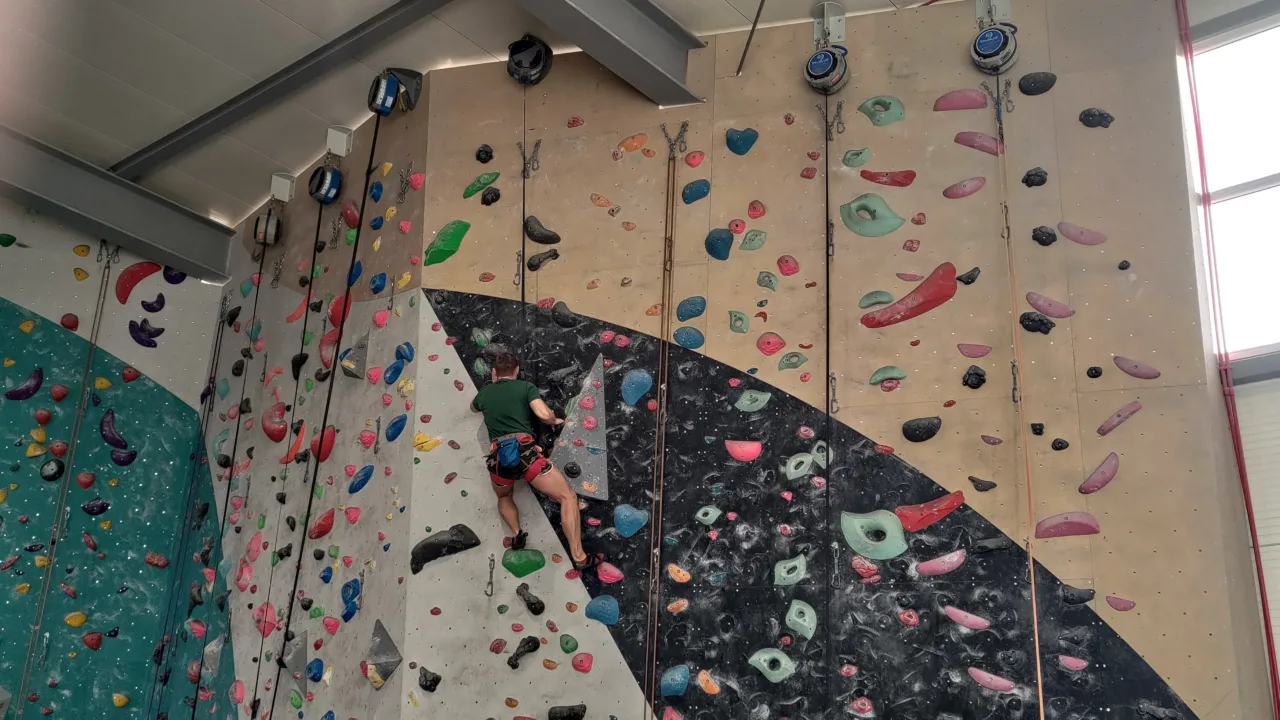
From time to time, someone dies or suffers serious injuries because, while climbing on an indoor gym, they forgot to clip into the auto belay (e.g., TruBlue). How does it happen that experienced climbers forget such a simple and critically important step? What can we do to protect ourselves from making this mistake?
Table of contents:
- What are auto belays?
- Accidents on auto belays are not rare
- Causes of accidents on auto belays
- How to prevent accidents on auto belays?
What are auto belays?
This is a system that allows climbing on an indoor wall without a human belayer. The climber clips a carabiner from a special webbing strap into their harness, and upon reaching the top or if they fall, they are slowly lowered on the strap.
Auto belays are a great tool for beginners. I often see groups of friends at climbing gyms who are clearly there for the first time and definitely don’t know how to belay a climber. Thanks to auto-belays, they can have fun together and get familiar with climbing without taking a belaying course or paying instructors to belay them. It’s also an excellent training tool for experienced climbers who happen to come to the gym alone. Auto belays are also used in the speed climbing discipline. In speed climbing competitions, auto belays are always used instead of human belayers, because a person couldn’t take the rope that quickly.
Accidents on auto belays are not rare
Surprisingly often, a climber forgets to clip into the webbing and, unaware of it, climbs unprotected. It doesn’t always end in an accident. Sometimes the climber or a bystander notices the lack of belay, and the person manages to get down unscathed. Unfortunately, sometimes it ends in death.
The reel below shows three cases of failing to clip into an auto belay. In the first, the guy was incredibly lucky because another person saved him by catching him mid-fall! In the second case, a guy training for speed climbing fell from the very top but miraculously survived. In the third case, an experienced female climber died.
The owner of two climbing gyms in Wrocław also wrote on his Facebook profile about how often such situations occur.
Here is an excerpt from his statement:
We’re back on this topic again… unfortunately once more. This time the news is particularly tragic – on our friends’ gym in Slovakia, a female climber died as a result of a fall from a great height. RIP.
Of course (sad that I’m using the word “of course”), the climbing was supposed to take place using an auto-belay. And of course, the user didn’t clip in. In response – all kinds of information and flags made no impression. The girl climbed regularly, she knew how, she was capable, she had completed a course, etc. So what’s wrong??? Do we forget, don’t we remember? Or is the system that unreliable? The devices work – manufacturers assure us.
The client (I deliberately use this word instead of climber) demands… How many times do we hear “but they have more…” or “somewhere else they have dozens…” and every time we look each other in the eye and ask whether to hang more of them? Increase the probability of YOUR mistake. Or maybe give up on it. The most common response is “install some photocell…” hmm, a photocell for what? For common sense. For the basics of safety – i.e., clipping into the belay?
I closely follow all kinds of accidents and incidents involving auto belays. And with fear I note that there are quite a few of them. And the pattern is always the same – I forgot to clip in and I’m climbing free solo (jargon for unprotected). What’s even more shocking – the climber, without any self-control, “takes”, sits back in the harness and… well, no one takes. They fall down!!
Our instructors (Anita, Renia, Beniu – you are GREAT!!) have already saved health/life five times – they noticed in time. They stopped the climb. One of the climbers was already at the very top by the chain – fortunately he didn’t panic… and Beniu acted lightning fast.
[…]
Once again, we kindly ask you to belay yourselves! To develop the habit: I clip in – I check. I go – I check. I “take” – I check! It’s your health and lives.
Sad statistics:
– Slovakia: two fatal accidents
several broken legs
– Czech Republic: one fatal accident
several broken legs
– Poland: several broken legs
damaged spine
that’s just the last two years…..
Paweł Pablo Sikorski, Climbing Instructor, Chief Instructor at CW Tarnogaj, Representative/Project Manager for TR-Walls (climbing wall construction company), and above all your fellow climber! Today a few years older…
Causes of accidents on auto belays
How is it possible to forget to clip in? I understood this after reading accounts from people who made this mistake and survived. You can notice recurring mechanisms in such stories.
In the video below, a woman who survived an accident caused by not clipping into the auto belay describes in detail how it happened.
She says that a lot was going on that day, she was thinking about various things. At the end of the day, she went to the gym to train on auto belays. By the time of the accident, she had already spent about an hour climbing non-stop, so she was tired. She was about to finish her session, but she saw someone solve a move on a route that she had trouble with. Thanks to that, she learned how to do it and, without thinking about anything else except that one move, she went to that route and started climbing without clipping into the auto belay. Fortunately, she didn’t manage to complete the route. She fell before the top, which is why she survived.
So you can see three factors that contributed to the mistake. First, a head full of various matters from the whole day. Second, fatigue from training. Third, fixation on thoughts about sending the route.
In the comments under this video, many people admit that they too have forgotten to clip into the auto belay. Some explain why they made the mistake.
Happened to me today, Stressed to the max all week. went to climb extremely focused, made it all the way to the top of the wall before i realized I wasn’t clipped in at all. @connorshoree
This is a similar psychological mechanism to the previous example. The mistake was caused by stress and fatigue from daily matters, plus fixation on climbing.
[…] I got into a certain mindset and had to make the moves. 3/4 way up on 5.11 looked down and realized I wasn’t clipped in. […] Everything else was secondary. Like tunnel vision. Now I double, triple check everything! @PeterMillette-g1e
What this climber describes is known in psychology as a flow state. It’s a state of complete concentration on the task at hand, where nothing else matters, you don’t think about anything else, only the task you’re performing. Actually, you don’t even think about the task – you just act. Athletes who enter this state often achieve their best results precisely when in it. But, as we see, it’s not good to be in this state when training on auto belays, because it can lead to forgetting about belaying.
We can also forget about it when we’re not maximally focused on climbing, but the opposite. We’re distracted, for example because we’re listening to a podcast at the same time.
I was climbing few years ago on autobelay and needed a couple of minutes for some rest. unclipped and forgot to clip in, since I was tired and distracted by a podcast. […] @angrypacman
Note that the cause wasn’t just listening to the podcast, but also simultaneous fatigue. Accidents, not only in climbing (I’ve read a lot also about aviation, especially skydiving), are very often caused by the overlap of several factors.
Another reason why the need to clip in can escape our brain is situations when something pulls us out of the routine of “clip in, climb, lower, unclip” or “climb, lower, climb, lower”.
[…] I made it about 25 feet up and fell on a hard move. […] I think it happened because I initially was clipped in, but then realized I left my chalk bag at the base of the previous route I had climbed, so then I went to grab it and forgot to clip back in when returned. This was also made a little more awkward by the fact that I worked at the gym… @mattrhodin7662
[…] I clipped belay off between reps to help some guy with his move and then went to the wall without thinkinh. I was totally pumped and wasn’t thinking straight. […] @surikatga
I also consider the following two comments very valuable:
It not happens only on auto belay. I am 68, climbing now over 50 years, safety checks are gone to be a habbit. But, yes a view days ago i was on a crack with my partner and i don’t no why, started climbing without tied in. Maybe focused on the crux move, whatever. That had happened never before. Thats why i don’t like climbing alone except bouldering. My partner called me back at once and we realized that we passed our normal partner check. Nothing happened but we got the message to be always alert and pay attention against each other. That rule can take although place in normal life. @harrybo670
I also had a bad accident as described here. What is astonishing is that you do it 1000 or even more times correctly (you check and you doublecheck always) and then one day it also happens to you. Every thing that can go wrong goes wrong one day. That is what I am afraid of always. One can really make the most incredible mistakes. This not only when you go climbing. @eugengspon
Climbing instructors talk a lot about the need to develop habits. To always check each other with a partner before rope climbing. To always tie a knot at the end of the rope, even if we’re sure there’s enough rope where we’re climbing. To always make sure we’ve clipped into the auto belay. Some recommend, after clipping, always weighting the webbing or even climbing 1 meter and jumping off.
I agree that habits are important, but they don’t always protect us from making a mistake. It can happen that even if we have a habit, one day something happens in our brain and we don’t perform that action this time.
Now look at one more account, quite unusual.
I’m an experienced climber, not reckless nor accident prone, but I had a bad day too.
My gym had set a bunch of bouldering problems for an upcoming competition, but had not yet taken down the surrounding auto belay routes. Bouldering is not normally my thing […], but I tried one of the easier looking boulder problems anyway. I got it on my first try, but then instead of jumping off, or downclimbing, my brain farted and I reached for a hold on a difficult project that I had recently got wired. I continued up on autopilot, got to the top at 28 feet, and then without noticing that I wasn’t clipped in, grabbed the rope with both hands as usual, and jumped off. The rope quickly slid through my hands and burned them without slowing my fall at all. […] @joelubich1017
What’s unusual here is that the climbing gym set boulder problems on a section of the wall normally used for auto belay routes. For those unfamiliar – bouldering is climbing on low walls (about 3-4 meters) without a rope, only with mats. Normally, climbing gyms have a separate area just for bouldering. I haven’t encountered creating boulder problems on tall walls intended daily for rope or auto belay climbing. This example, however, shows well how the human brain works. Even though this time he was bouldering there, his brain switched to “I’m here, so I have belay” mode.
Another example explains how climbers sometimes don’t notice the flags to which the webbing is attached and it doesn’t bother them to start climbing unprotected.
It happened to me also one time, luckily I realized after 1 hold but it was scary as hell, as I could easily have continued the route without noticing. In my case, there was the autobelay flag yes at the beginning, but I was doing a route at the left of it, not covered exactly by the flag… The flag should be definitely larger I guess … Well, now I always take care of that, but yeah not surprised accidents can happen, cause with routine, you forget things sometimes, it can happen to anyone. @Furansowakun
Accounts of people who didn’t clip into the auto belay can also be found in the Polish part of the internet.
One appeared as a comment under one of the posts on the wspinanie.pl Facebook profile.
If I may add my two cents, in 2021 I myself didn’t clip in, reached the end of the wall, fell for the lower, and… realized I wasn’t clipped in. I always had a procedure… I clip in, let go, hear the click of the gate closing, check again. What failed that one single time… my head. I was somewhere else mentally, my friend – my little dog – was passing away, in case something happened I had my phone on the bench, which I never took under the wall. The phone rang on the penultimate climb. I unclipped, checked, thought – one last climb. And it was the last. As I went, I had the webbing in front of me the whole time. I was 100% sure I was clipped in. Who made the mistake? Me – primarily. Could my mistake have been reduced… yes, first think about every climb, to the end, as always. Concentration here and now! Second… a thick mat could have saved my ass, third a person or “something” that checks and doesn’t allow a mistake. Bad luck that the person who was always nearby went to pee. The main problem with machines is human error – lack of concentration on the job, and lack of a partner who, if needed, will give you a telling-off. Jacek Kotus
We see the same mechanisms here that you’ve already read about above. First, head occupied with important stressful matters – in this case, the dog’s poor condition. Second, breaking the routine. His brain was in “climbing mode,” but he unclipped to check who was calling.
Under another post on the same profile, a person who works at one of the climbing gyms in China commented.
We noticed an interesting pattern that accidents increase sharply in the month when sudden heat waves arrive — maybe some neurologist can comment. Ola Przybysz
I’ll comment – climber and psychologist :) Heat waves increase fatigue and easily lead to dehydration, especially if they come suddenly when the body isn’t yet accustomed to high temperatures. This isn’t just physical fatigue. High temperature causes blood vessels to dilate. This is how the body cools itself, but at the same time it means less blood reaches the brain, causing it to function worse. Heat can also cause irritability, which also leads to reduced concentration.
Descriptions of situations where a climber didn’t clip into the auto belay can also be found in my database of climbing accidents and incidents. Here is an excerpt from one of them.
At that moment I was standing between two TruBlue mats. On the left was the auto belay I planned to clip into. On the right, the one the climber had clipped into. In front of me began the route I decided to do now. In my field of vision there was no webbing from the auto belay, because the webbing of both devices was to the right and left of me.
I started climbing that route. I had done it many times as a warm-up.
I reached the top and realized I had forgotten to clip in.
So we have a similar situation to the one described earlier. The climber involuntarily ignored the mat because it didn’t interfere with climbing.
In another case, ignoring the mat was even easier because it didn’t cover the route at all.
After onsighting about 9 routes in a sector with two auto belays, I moved to another sector intending to continue climbing.
In that sector, someone had clipped the TruBlue webbing to a bench (to allow top-rope or lead climbing).
On that bench was my water bottle, which I grabbed on the way. After hydrating, I headed to the wall to tackle a 6b route on red holds that I had been able to climb fairly smoothly for some time. At about 2m height, I made a relatively dynamic move to a hold, but this time I couldn’t hold it. In a fraction of a second, I realized I was falling… and that I wasn’t clipped to the webbing.
The third description comes from a witness to the incident. This is what he writes about the girl who fell because she didn’t clip in.
she kept repeating that she had had a hard day and was tired
How to prevent accidents on auto-belays?
After a fatal accident at the Makak climbing gym in Warsaw, a team was formed that created recommendations for operators of gyms equipped with auto belays. You can read about them here: wspinanie.pl/2025/11/bezpieczenstwo-na-sciankach-zalecenia-automaty/.
Some of their recommendations seem sensible to me. Especially covering the first holds and steps with a mat, forcing the need to clip in before starting to climb. Others, however, sound pointless. Especially training lasting at least 45 minutes and certificates that clients have to renew every six months. After all, people don’t have accidents because they don’t know how to use auto belays. And I really don’t know what a training session on their use would cover to take as long as 45 minutes.
In my opinion, we should primarily think about what we, as climbers, can do to avoid making a mistake when climbing on an auto belay.
I recommend the interview with Bogusław Kowalski, who as a court expert deals with climbing accidents. You can read it here: wspinanie.pl/2025/07/samokontrola-i-edukacja-o-zasadach-bezpieczenstwa-na-scianach-wspinaczkowych-rozmawiamy-z-boguslawem-kowalskim/.
Here’s what Bogusław Kowalski recommends:
For many people my suggestion may seem ridiculous, but it involves talking to yourself, to the carabiner, or perhaps to a chosen, nearest hold. In my imagination it looks like this:
- Now I unclip the carabiner from the triangle.
- I clip it to the connector.
- I check if the gate closed.
- I pull the webbing down, checking if it retracts into the auto belay.
These sentences should become a habit, and I would try to instill in my students to learn them by heart. You can say them out loud, and their main goal is to be here and now.
In my opinion, this is very good advice, but I would add one more thing. Learn to observe your own physical and mental state. If something is happening that could lead to distraction, an orange warning light should go on, prompting you to increase vigilance. “Oh, I’m already very tired. In this state I might make a mistake, so I need to especially check if I’m definitely clipped in.” Or: “I’m so psyched for this route! I’m only thinking about the crux! Stop! Remember belaying.” Or differently: “My thoughts are drifting again to my sick grandma. Today it will be hard for me to be here and now. Maybe I won’t climb today, I’ll do hangboard training instead.”
The ability to light such orange warning lights is, in my opinion, the best thing we can do ourselves to minimize the risk of an accident on an auto belay. Minimize, but not eliminate, because the human brain is far from perfect and anyone can sometimes make a mistake.

 Thank you :)


Leave a Reply