


The difficulty level of MTB trails is marked with colors, similarly to ski slopes. So we have green, blue, red and black trails. But what does that really mean? How easy are green trails? What can you expect on blue and red ones and how difficult are black ones? The answer to these questions is not simple.
The difficulty scale I’m talking about refers to technical difficulty, not fitness level. It applies to trails in bike parks, singletracks, unofficial enduro trails, etc.
How do you know what color a trail is?
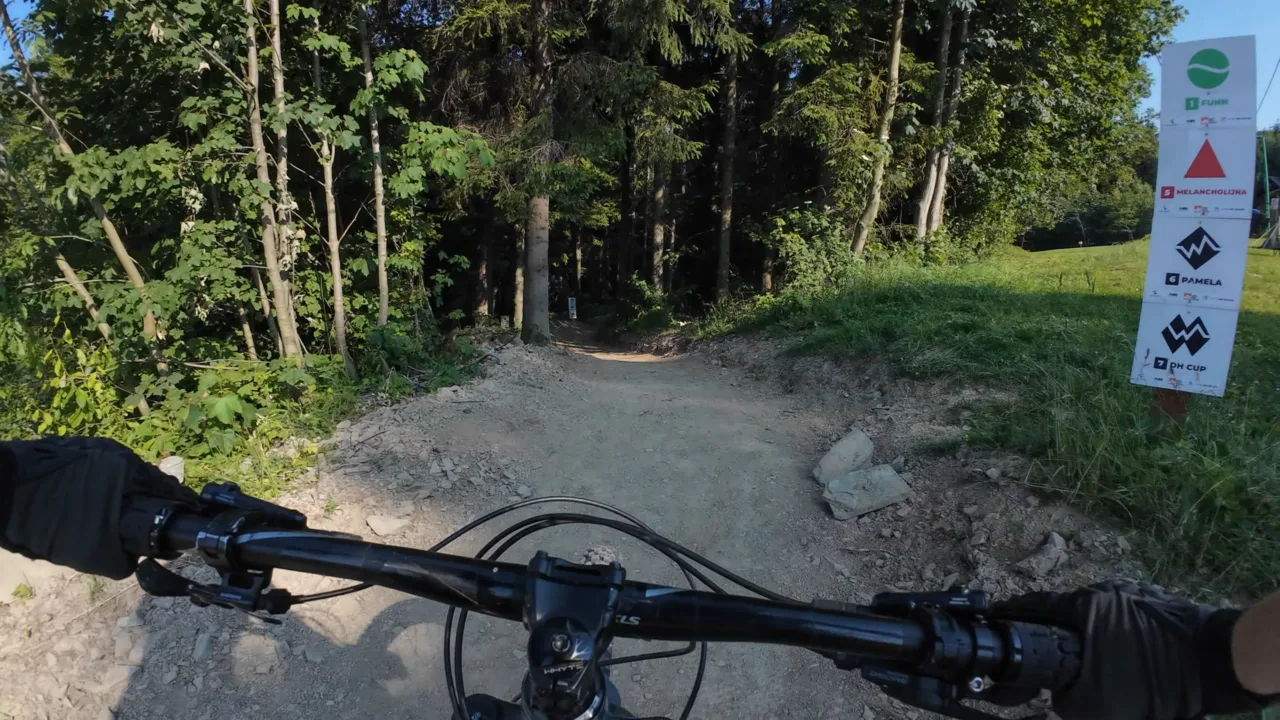
In bike parks, trails are always clearly marked with colors. Every bike park has a map with trail names and colors, and there are signs at the entrance to each trail.
For singletracks it varies. For example, the Bystrzyca Singletracks are marked with colors according to difficulty. However on the Glacensis Singletracks the color of the trail does not mean the level of advancement.
Unofficial trails, i.e. enduro trails built by riders themselves without public funding, usually have no signs at all.
The website trailforks.com (there is also an app) comes to the rescue. It contains a huge database of MTB trails marked with colors according to difficulty level. The database is created by the users themselves, so it also includes many unofficial trails. Users can also rate trails both in terms of “fun factor” and perceived difficulty, as well as post reports (e.g. about fallen trees or other problems), add comments, photos and videos from the trails. This is not a sponsored post! I really believe that this website/app is a must-have for anyone who enjoys downhill disciplines of cycling.
How difficult are green trails?
Just like on skis, green MTB trails are intended for complete beginners. They are most often so-called flow trails, i.e. specially smoothed trails. Sometimes they have no technical elements at all, only gentle flat turns. They can also have gentle berms and small rollers.
Such is, for example, the Zielony Zygzak (Green Zigzag) in Bike Park Skolnity in Wisła.
On green trails there can also be small tabletops, i.e. jumps without a gap that you can roll over if you don’t want to jump.
Sometimes the berms are quite large. This is the case, for example, on the green trail in Dolni Morava in the Czech Republic.
By design, a green trail should be rideable for everyone. The only green trail I know that I would not recommend for complete beginners is the Funn trail in Soszów in Wisła. In the lower part of this trail there are tabletops as big as those I’ve seen on blue and red trails.
How difficult are blue trails?
Blue trails have a very wide range of difficulty.
For example, the Flow Country Trail in Geißkopf in Germany has gentle berms, rollers and occasional small gentle tabletops. Some people would say it’s a green trail.
But the Niebieska Fala (Blue Wave) in Skolnity is also blue, where there are – I’d say – 4-6 meter tabletops and step-downs (a jump where the landing is a bit lower than the takeoff). I would mark this trail as red.
On average, on blue flow trails you can expect berms, rollers and tabletops with a jump of about 2-3 meters. This is what the blue trail in Dolni Morava looks like, for example.
Some enduro trails are also blue, i.e. trails with a natural character. I don’t know many of them, because enduro trails are usually more difficult, but you can find some that could be called blue.
Such is, for example, the unofficial trail “Na Piwo” in the Owl Mountains. It runs on forest floor without any sharp turns or big steep sections. Although I crashed there because there is one more difficult spot when descending onto a gravel road ;)
Many singletracks are also in the blue range, for example Rudka in the Glacensis network, which has some small rocks, roots and a few sharp berms.
On average, most beginners are able to ride most blue trails. Of course “most” does not mean everyone. There are more fearful or less physically fit people for whom blue trails will be too difficult at the beginning.
Just like on green trails, on blue trails you don’t need an expensive bike. On most trails at this level you can have a lot of fun on a hardtail or on a full-suspension bike with a small travel.
How difficult are red trails?
Red trails usually already require some technical skills to be able to ride them at all, even slowly. Sometimes more, sometimes less, because just like with blue, the range of difficulty here is also wide.
In the case of flow trails you can expect 4-8 meter tabletops. Such are, for example, on the red trail in Dolni Morava.
On red trails there can also be other obstacles, for example drops, i.e. jumps from which you jump down. There can also be gaps, i.e. jumps with a hole. Such obstacles are, among others, on Lisica in Gravity Park in Białka Tatrzańska.
In bike parks on red trails, jumps with gaps usually have a bypass for people with lower skills. Drops also have bypasses or are small enough that you can roll them.
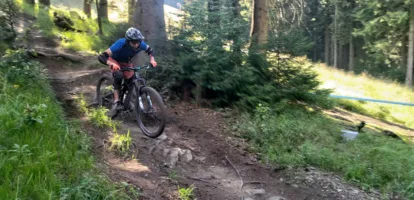
Red enduro trails are usually full of roots and/or rocks, often have sharp turns, and can also be steep. There can be so-called steep chutes, i.e. descents so steep that you cannot stop on them.
An example of a red trail with a natural character in a bike park is Gargamel on Czarna Góra.
Unofficial enduro trails are very often at the red level. One of many examples is the LGG trail on Ślęża.
There are also trails that are marked red on Trailforks but are really quite difficult. For example Borsuczyca in Węgierska Górka, which has very steep sections. When watching, keep in mind that videos don’t show the slope well and it is usually steeper than it looks on film.
How difficult are black trails?
Black flow trails usually have very large berms and several-meter or even bigger jumps. They are not always tabletops. On black trails there are often gaps and sometimes they also have several meters of flight. I don’t ride such trails.
I ride black enduro trails, but I don’t always ride them in their entirety. On trails of this color there are places where I push the bike. Generally, black trails are often steep, there are more steep chutes than on red ones, and there are often very sharp turns called “hairpins”. It is impossible to ride such trails without technical skills. Even slowly, because there are places where you cannot descend slowly.
An example of a natural black trail in a bike park is Klakier on Czarna Góra.
Downhill trails are also black. Downhill is a slightly different downhill discipline than enduro. DH trails are usually built with very fast riding in mind, they have big drops and gaps. I rarely ride such trails because I don’t have the skills or the right bike for such heavy riding. Sometimes, however, I try my hand and jump smaller jumps. That was the case at the DH Cup in Kasina.
Double black / Proline trails
Trails that are too difficult to fit into the black category are marked in bike parks as double black and on Trailforks as orange and described as proline. I usually don’t push myself onto such trails because I know they will be too difficult for me.
Recently I tried a trail that is orange on Trailforks – Ptačí perspektiva on Trutnov Trails in the Czech Republic. Of course I pushed the bike in the most difficult place.
Advantages and disadvantages of this difficulty scale
The only advantage that comes to my mind is the fact that many people are familiar with this scale because they have experience with ski slopes. They know that a green trail is for beginners and a black one for advanced riders. They probably won’t ride a red one without skills, knowing what red trails on ski slopes look like.
The disadvantage is that 5 levels are simply too few to cover the entire range of MTB trail difficulty. MTB trails do not differ only in slope like ski slopes. Difficulty depends on many aspects and a steeper trail may require less skill than another less steep one. For example, the second one may be more rocky.
There are also no generally established standards for rating the difficulty of trails that have demanding sections but can be bypassed. Should it be marked black because there are 5-meter gaps or red because if you bypass the gaps it’s not that hard?
I also have the impression that bike park owners often really want to show that they have trails of different difficulty levels. The easiest trail in a bike park is usually green or blue, even if it’s not that easy at all. For example, Milky Way on Czarna Góra is marked blue, but it has big tabletops and rocky berms. In my opinion it falls into the red range, but if they marked it that way, customers would see that they basically only have red and black trails.
All this means that trail ratings are uneven and a blue trail in one bike park can be more difficult than a red one in another, and a black one can be easier than another red one. It’s worth checking Trailforks and seeing how users rate a given trail. The colors on Trailforks are sometimes different from the official markings in bike parks and in such situations the Trailforks markings are usually more accurate.
Trailforks does not solve all problems, however, because as I mentioned above, 5 levels are simply too few, which is why there is a wide range of difficulty within one color. For example, the black trail Boulder on Trutnov Trails is clearly easier than the also black Střílna in the same trail complex.
Then there are issues of individual predispositions and skills. Some people fly well on jumps but rarely ride natural trails, so a red flow trail will be easier for them than a red enduro trail. Others cope well on technical trails where you have to slowly negotiate a very sharp turn, but they are afraid of high speeds and long jumps, so a black technical trail may be easier for them than a red flow one.
In general, the MTB trail difficulty scale should be treated very approximately. On the first ride, if you know nothing about a given trail, it’s worth being aware that it can vary. Sometimes you can be surprised :)

 Thank you :)
Leave a Reply